Tel: +86-19906868508
E-mail: info@sihanmed.com

Tel: +86-19906868508
E-mail: info@sihanmed.com
The endoscopy devices industry continues to play a central role in the global shift toward minimally invasive diagnosis and treatment. As procedure volumes rise across gastroenterology, ENT, urology, and general surgery, demand for reliable endoscopy equipment, machines, and accessories is increasing worldwide.
The top companies in the endoscopy devices industry are manufacturers that offer certified endoscopy equipment, reliable accessories, and scalable production for global markets. In 2025, leading endoscopy manufacturers stand out through integrated device portfolios, strong OEM capabilities, and the ability to support hospitals and distributors with consistent quality and long-term supply stability.
Leading companies in the endoscopy devices industry are typically endoscopy manufacturers that design and produce complete systems, core equipment, and supporting accessories under certified quality standards. These companies serve hospitals, surgical centers, distributors, and OEM brands by offering stable production capacity, regulatory compliance, and long-term supply continuity. Some of their products, such as specialized urology scopes, are often referenced by nephroscope storz price in procurement analyses.
Rather than focusing on a single product, top endoscopy companies usually operate across multiple segments, including endoscopy machines, rigid and flexible devices, and procedure-specific accessories. Among these global players, partnerships with rigid endoscope suppliers enhance supply continuity for hospital procurement teams.
While the industry includes many players, most top companies fall into several clearly defined categories, each with distinct strengths.
Endoscopy equipment manufacturers focus on producing the core infrastructure of endoscopy systems, such as processors, light sources, imaging platforms, and control units. Equipment from these manufacturers is often supported by endoscopy parts supplier networks for long-term maintenance and quick parts access.
Key strengths include:
Advanced imaging and signal processing integration
Stable system performance for high-frequency clinical use
Compatibility with a broad range of endoscopy devices
Compliance with international medical regulations
These manufacturers are often preferred by hospitals and healthcare groups seeking long-term system reliability.
Endoscopy machine manufacturers specialize in the development and assembly of complete endoscopy platforms that combine hardware, optics, and electronics. Their strategic value is often compared with that of flexible ureteroscope manufacturers when facilities seek multimodal imaging solutions.
Typical advantages include:
System-level engineering expertise
Improved workflow integration in operating rooms
Easier maintenance and system upgrades
Strong after-sales technical support
Their products form the backbone of modern endoscopy suites. Integration with arthroscopy instruments suppliers also helps multi-discipline surgical departments streamline overall device procurement.
Endoscopy accessories manufacturers play a critical role in daily clinical operations by supplying consumables and supporting devices such as biopsy forceps, valves, trocars, light cables, and cleaning accessories. When evaluating global portfolios, clinicians often review both OEM outputs and used olympus endoscopy equipment accessory histories to gauge total cost of ownership.
Core strengths include:
High-volume, cost-efficient manufacturing
Rapid product iteration
Customization for specific procedures
Recurring demand from hospitals and distributors
Accessories manufacturing has become one of the fastest-growing segments of the endoscopy market. Growing demand has led some accessory makers to align with medical endoscope camera suppliers for better imaging compatibility.
OEM-focused endoscopy manufacturers support private-label brands and regional distributors by producing endoscopy products under customer specifications.
Key benefits include:
Flexible design and branding options
Scalable production for global markets
Experience with CE, FDA, and ISO compliance
Reduced time-to-market for new brands
OEM partnerships are increasingly shaping the competitive landscape of the industry. OEM players also engage with endoscopy repair parts supply chains to ensure fast service readiness.
Top endoscopy manufacturers differ from general suppliers through in-house manufacturing control, engineering expertise, and system-level integration. For instance, Olympus mini nephroscope is widely adopted in leading urology departments, reflecting the brand’s clinical impact. Strong collaboration with China endoscope camera providers enhances imaging module flexibility for integrated systems.
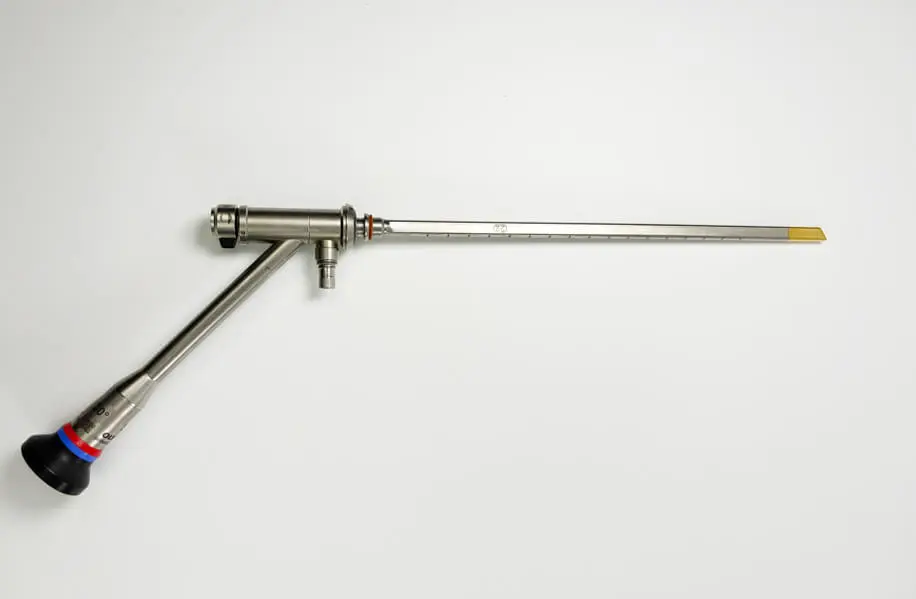
olympus-mini-nephroscope
Buyers increasingly favor manufacturers that can support both current procurement needs and future expansion.
Professional buyers typically compare endoscopy equipment suppliers across several key dimensions.
A reliable endoscopy manufacturer demonstrates:
Precision machining and assembly
Optical and mechanical integration
Controlled production environments
Documented inspection and testing processes
These capabilities directly impact product consistency and clinical performance. Robust manufacturing capability often parallels strong rigid endoscope manufacturer portfolios in diversified device offerings.
Top endoscopy equipment manufacturers operate under:
ISO 13485 quality management systems
CE and FDA compliance frameworks
Traceable materials and production records
Regulatory readiness reduces risk for international buyers and OEM brands.
Manufacturers with broader product portfolios can support:
Multiple clinical departments
Long-term supply contracts
OEM and private-label expansion
Scalability has become a key decision factor in 2025.
Key market takeaways for the endoscopy devices industry in 2025 include growing demand for integrated systems, increased use of disposable accessories, and rising reliance on OEM manufacturing. Buyers are prioritizing quality consistency, supply stability, and regulatory readiness over short-term cost advantages. Procurement teams now often evaluate supplier portfolios that include both core systems and endoscopy scope parts listings to ensure future maintainability.
These trends are reshaping how hospitals, distributors, and brands select manufacturing partners. Market shifts also encourage evaluation of endoscopy machine parts options alongside OEM strategies.
Healthcare providers increasingly prefer integrated endoscopy platforms that reduce setup complexity and improve procedural efficiency. This trend favors manufacturers with system-level expertise.
Infection control and efficiency concerns are driving demand for disposable and semi-disposable endoscopy accessories, benefiting specialized accessories manufacturers.
OEM endoscopy manufacturing continues to expand as brands seek to reduce development costs and accelerate market entry. Manufacturers with OEM experience are gaining strategic importance.
In 2025, endoscopy manufacturers are no longer just equipment suppliers. They are strategic partners supporting innovation, compliance, and global distribution, like the endoscopic surgical component manufacturer Sihanmed. Buyers increasingly evaluate manufacturers based on long-term collaboration potential rather than unit pricing alone. Many organizations now supplement in-house training with rigid endoscope repair training to maximize uptime and clinical reliability. This broader strategic role also intersects with evolving endoscopy parts for sale ecosystems to support service readiness.
Endoscopy devices include medical equipment, machines, and accessories used to visualize and treat internal organs through minimally invasive procedures.
They are manufactured for hospitals, surgical centers, distributors, and medical device brands, often through OEM partnerships.
Manufacturers produce devices directly, maintaining control over quality and customization, while suppliers may distribute products from multiple manufacturers, including components like rigid endoscope parts.
Yes. Growth continues due to aging populations, minimally invasive surgery adoption, and expanding healthcare access. Equipment such as the TC300 Karl Storz highlights the increasing sophistication of surgical systems.
OEM manufacturers help brands reduce development time, manage costs, and scale production efficiently. They may also source imaging modules from endoscope camera China, enhancing the overall system performance.

With years of dedication to the medical equipment industry, Shengjun He has leveraged his solid professional expertise and keen insight into industry trends to establish Sihan Medical as a leading force in the endoscope repair sector. Prior to founding Sihan Medical, he accumulated extensive experience in medical device maintenance—a foundation that proved instrumental for his entrepreneurial journey. His background spans hands-on equipment repair, technical R&D, and management, granting him comprehensive understanding of medical devices, from their underlying technology to market demands.
This is the first one.